

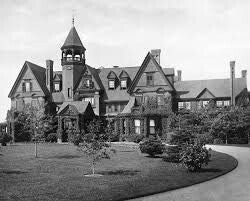
Loramoor Estate History
Completed in 1900, Loramoor was a 20,000-square-foot Tudor Revival mansion built on 133 acres along the south shore of Lake Geneva.
It was commissioned by Chicago lawyer and financier James Hobart Moore and named “Loramoor” in devotion to his wife, Lora Small Moore.
The estate was designed by Jarvis Hunt of Chicago, educated at MIT and nephew of architect Richard Morris Hunt. Loramoor was among Hunt’s earliest major commissions.
Loramoor’s curved plan followed the contours of the land to maximize lake views, sunlight exposure, and protection from north winds. It was featured prominently in Architectural Record (1904).
For 1900, the mansion’s systems were unusually advanced: electric lighting, hydraulic elevator, central vacuum system, a servants’ bell system, and sound-dampened floors. The basement also included recreation space including a bowling alley.
After Moore’s death in 1916, the estate was sold (1925) and later used as a country club. In 1951 it was purchased by the Franciscan Order and renamed Queen of Peace Friary; a Tudor-compatible wing was added in 1953.
The main mansion was demolished in October 1984. The surviving gatehouse and stables remain as historic landmarks that preserve the site’s architectural legacy.
Today, the Loramoor grounds provide a distinctive historic setting for a high-profile charitable weekend benefiting Make-A-Wish Foundation®.


